From Limbé to the Top: Dendy Desnoyers’ 17-Year Journey to Lead Haiti’s Inspection Générale des Finances (IGF)
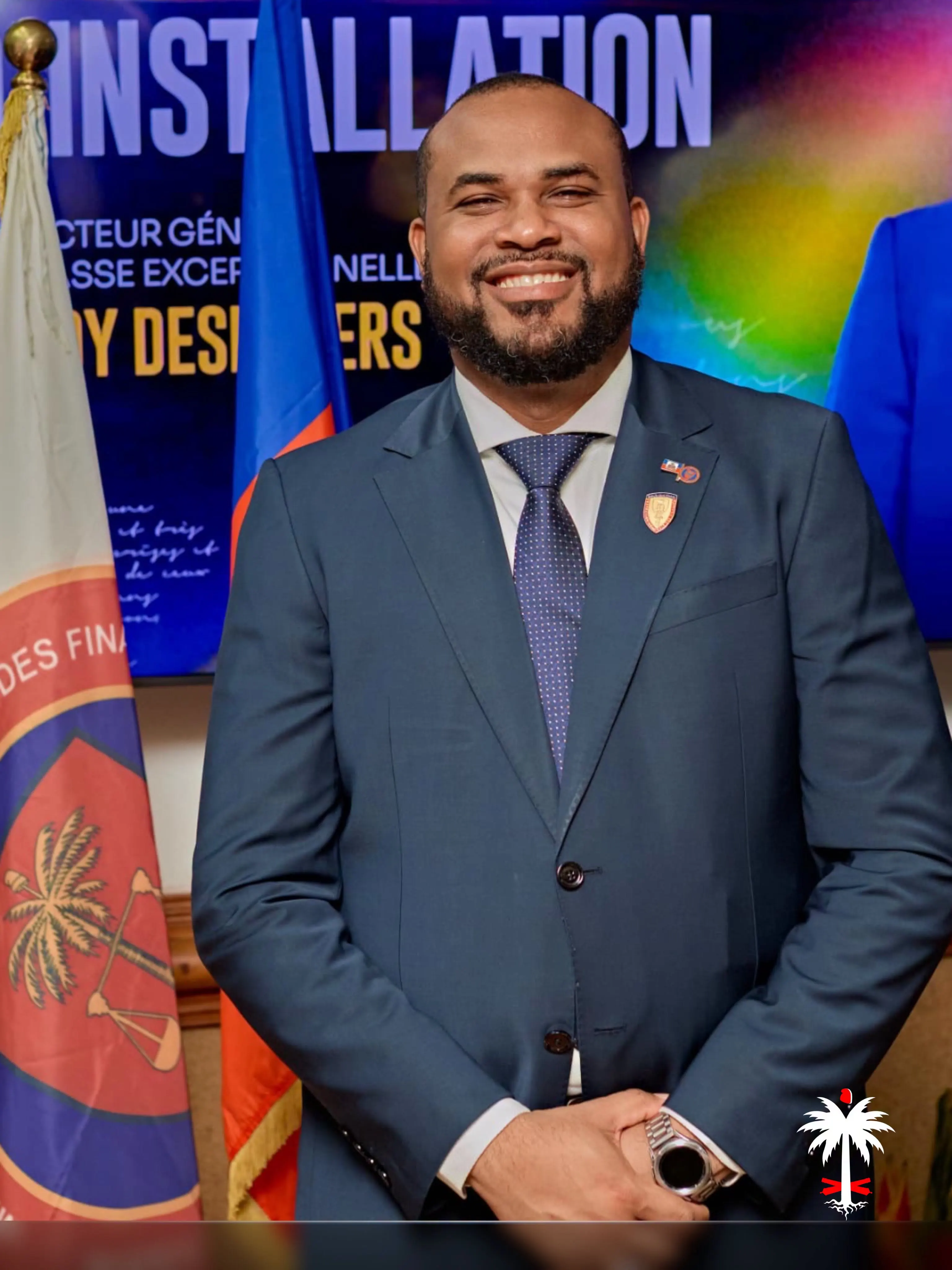
In November 2008, a young man from Limbé walked into the Ecole Nationale d’Administration Financière (ENAF) as a trainee with a simple ambition: to do his job well. Seventeen years later, that same man, Dendy Desnoyers, now sits at the head of Haiti’s Inspection Générale des Finances (IGF) as its Director General, the institution’s highest office.
His appointment in August 2026, with the rank of Inspecteur Général under Article 8 of the March 17, 2006 decree that created the IGF, caps a career built almost entirely from within the institution, one rung at a time.
A career built rung by rung
Desnoyers entered public administration through an external competitive exam for the ENAF, a specialized school under Haiti’s Ministry of Economy and Finance. He spent two years there, one in general training, one specializing in the Treasury track, before completing a probationary internship at the IGF between October and December 2010. He formally joined the institution on Jan. 3, 2011, as a public finance technician.
By May 2011, he had been sworn in as an Inspecteur Assistant, first echelon, under Article 26 of the same 2006 decree. From there, he climbed every rank in the corps, “Inspecteur Assistant”, then “Inspecteur Vérificateur”.
Desnoyer spent at least a year in each of the IGF’s technical directorates: a year and a half in the “Direction de Contrôle des Administrations Publiques”, eight years in the “Direction de Surveillance des Capitaux Publics (DSCP)”, and a year and a half in the “Unité de Coordination des Activités d’Inspection (UCAI)”.
He was promoted to “Inspecteur Général” and named head of the DSCP, a post he held for four years and four months before his appointment as Director General this past August.
“The function is a responsibility, not an end in itself”
Asked what reaching the top of the IGF means to him, Desnoyers is disarmingly modest. Becoming Director General, he said, was never the goal he set out to achieve.
“When I began my career at the IGF, my objective was much simpler: to do my job well every day, to honor the responsibilities entrusted to me, and to contribute, at my level, to the smooth functioning of the institution while climbing the ranks,” he said. “That path was built gradually, over more than fifteen years of my career. I started at the lowest grade, at the smallest echelon, and I advanced through the responsibilities that were given to me. Each stage was the result of the work accomplished, the results obtained and the professional evaluations carried out over the years.”
He is careful to separate the milestone from the mission. “I do not consider the ultimate goal to be becoming Director General. The function is a responsibility, not an end in itself,” he said. “What gives meaning to this journey is rather what we are able to bring to the IGF, and more broadly, to public administration, putting the experience acquired, the skills developed and the values that have guided our path at the service of public performance, good governance, transparency and better management of the State’s resources.”
“The real objective remains the same as at the start of the journey,” he added. “To carry out one’s work with seriousness, rigor and dedication, and to contribute, at every level of responsibility, to improving public administration.”
Overcoming skepticism about the auditor’s role
The obstacles Desnoyers faced in his rise, he said, were structural more than personal. The auditor’s profession, he explained, has long been met with a degree of wariness from public managers in Haiti, rooted in a limited understanding of what internal audit actually does.
“Over the years, this distrust toward the Inspecteur des Finances has eased,” he said. “Public managers have gradually come to understand that the IGF’s approach does not consist solely of controlling or pointing out shortcomings. Above all, it aims to support managers in improving their practices.”
On a personal level, Desnoyers credited his family for carrying him through difficult stretches of his life and career. “Despite the difficulties encountered over the course of life, I have always benefited from the constant support of my parents and, more broadly, my family,” he said. “That support gave me the strength to overcome these trials and to see them as experiences. They fed my ability to draw lessons from every situation and to guide my choices with much greater discernment.”
A five-year plan, and a project close to his heart
Since Desnoyers joined the IGF in 2011, the institution’s work has been guided by five-year strategic orientation plans. The current one, covering 2024 to 2029, was adopted in October 2024, and Desnoyers helped shape it while still serving as an Inspecteur Général. It rests on five priorities: strengthening the IGF’s institutional, organizational and professional capacities; managing its human, financial and material resources more efficiently; consolidating its core mission and standing; deepening cooperation with internal and external partners; and improving communication and public perception of the institution.
Early results are already visible, Desnoyers said. The IGF has carried out outreach activities in Port-au-Prince and in provincial cities to make its mission better known among local and departmental public managers, civil society organizations, academics, teachers and students. The institution also helped coordinate the “Salon du droi”t, a legal affairs forum held annually from 2023 to 2026, and marked its own 20th anniversary in March 2026 with exhibitions, panel discussions and workshops.
But one project stands out as particularly close to his heart: building a corps of internationally certified internal auditors within the IGF. “This objective, written into the 2024-2029 strategic orientation plan, is an essential lever to further strengthen the quality, credibility and recognition of the IGF’s work,” he said. “We will work resolutely to achieve it by 2029.”
“Our ambition is to continue implementing this strategic orientation plan with a renewed approach,” he said. “If some objectives remain to be reached and the challenges are still significant, we are convinced that with the support of leadership and the constant commitment of motivated colleagues, we will be able to meet them.”
From Limbé to Cap-Haïtien, and beyond
Desnoyers was born in Limbé, in Haiti’s North department, on a first Wednesday of October, but grew up and came of age in Cap-Haïtien, where he completed all of his early schooling.
Outside the halls of the IGF, Desnoyers describes himself as a sports enthusiast, football, basketball, tennis and combat sports among his interests, as well as a traveler drawn to discovering new cultures, and a longtime admirer of fine fragrances.
Music holds a special place in Desnoyer’s life, particularly the classics of the 1970s and ’80s; he counts himself a devoted fan of Grand Orchestre Septentrional and Nu Look, two of Haiti’s most storied bands.
He also follows new technologies and aeronautics and space science closely, enjoys documentaries on history and tourism, and is a student of his own country’s history, “which allows me to better understand and appreciate the richness of our heritage,” he said.
“Above all,” Desnoyers said, “I love my country.”
I do not consider the ultimate goal to be becoming Director General. The function is a responsibility, not an end in itself