Bois Caïman: the Night Haiti's Revolution Was Born
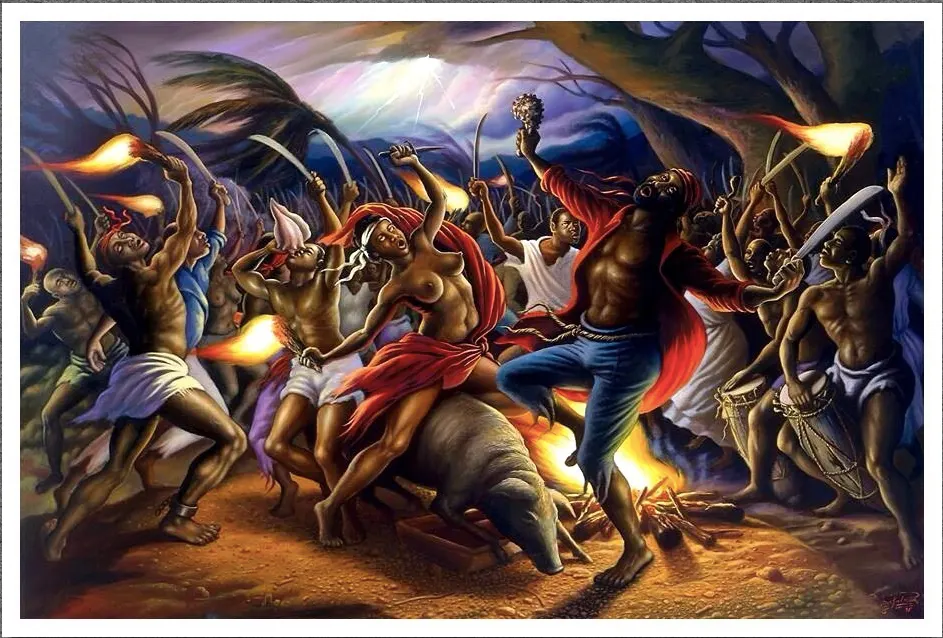
“The god who created the sun that gives us light… who holds up the ocean, who makes the thunder roar. Our god has ears to hear. He watches us from where he is hidden in the clouds. He sees all that the white man makes us suffer.” — Dutty Boukman’s prayer, Bois Caïman, August 14, 179.
That prayer is the closest thing Haiti has to a birth certificate. Passed down through oral tradition and later written accounts, it is remembered as the invocation that opened one of the most consequential nights in the history of the Atlantic world: the Bois Caïman ceremony, held in the forests near Morne Rouge, not far from present-day Cap-Haïtien, on the night of August 14, 1791.
Within days, revolt would sweep the northern plain of Saint-Domingue. Within thirteen years, it would end in the founding of Haiti, the first free Black republic on earth.
A prayer against a slave colony
Saint-Domingue in 1791 was the richest colony in the French empire, and one of the cruelest. Its wealth in sugar and coffee was extracted from the bodies of enslaved Africans worked, often deliberately, to death within a few brutal years, then replaced by new arrivals off the slave ships.
A majority of the enslaved population at Bois Caïman had themselves been born free in Africa; many still remembered what freedom felt like. Overhead, the language of the French Revolution, liberty, equality, the rights of man, drifted across the Atlantic, spoken by colonists who had no intention of letting it reach the people they enslaved.
Boukman’s prayer answered that gap directly. Where the colonists’ god, as the prayer has it, “asks him to commit crimes,” the god of the enslaved “wants us to do good” and “orders us to vengeance.” It was, in effect, a declaration that the moral order the colonists claimed for themselves did not apply, that a higher and older justice had already sided against them.
Inside the ceremony
According to the tradition passed down through generations of Haitian, the events of that night unfolded in two stages. Enslaved delegates from plantations across the northern plain first met in daylight to plan an uprising, choosing leaders and settling on a course of action. Then, after dark, came the ceremony itself: a Vodou service presided over by Dutty Boukman, a houngan, or priest, and Cécile Fatiman, a mambo, or priestess, said to be the daughter of an African woman and a white Corsican.
Picture the scene : a stormg athering overhead, rain and wind moving through the trees, thunder answering the drums. Men and women who had spent their lives in bondage stood together in the dark, many of them meeting in secret for the first time as something other than strangers on separate plantations. Fatiman was seized by the spirits mid-ceremony, dancing with a knife in her hand as the crowd’s grief and fury poured out into chant and movement.
At the center of the ritual was the sacrifice of a black creole pig. Its throat was cut, and its blood, still warm, was collected and passed among those gathered, each person drinking or being marked by it in turn. The shared blood sealed a binding oath among everyone present, a pact of secrecy and mutual defense, witnessed by the spirits, that no one at Bois Caïman was walking away from what came next. Bound by that oath, the delegates dispersed before dawn to carry the plan back to their plantations.
From the forest to the field
The delegates did not wait long. Within days, fires were burning across the northern plain as plantation after plantation rose up, an insurrection historians widely regard as the opening chapter of the Haitian Revolution.
Boukman did not live to see where it led; he was killed in battle that November, and French forces displayed his severed head in public, hoping to break the rebellion’s morale by proving its leader was only a man. It didn’twork. The revolt held. Slavery was abolished in the colony in 1793, then across the French Republic the year after. When Napoleon’s France tried to restore slavery in 1802, the war reignited, ending at the battle of Vertières in November 1803. On January 1, 1804, independence was declared. Saint-Domingue became Haiti.
More than two centuries later, Bois Caïman remains one ofthe most potent symbols in Haitian national memory. Every August 14, Haitians at home and in the diaspora mark the anniversary.
The freedom declared in 1804 was first claimed a decade earlier, in the rain and the dark, by people the colonial order had tried to make invisible, and who answered with a prayer of their own.
"The god who created the sun that gives us light... who holds up the ocean, who makes the thunder roar. Our god has ears to hear. He watches us from where he is hidden in the clouds. He sees all that the white man makes us suffer."